

- Home
- Services
![Web Design & UI/UX Design]() Web Design Services
Web Design Services ![Web Development]() Web Development
Web Development![E-Commerce Development]() E-Commerce Development
E-Commerce Development![Mobile Apps Development]() Mobile Apps Development
Mobile Apps Development![Online Reservation System]() Online Reservation System
Online Reservation System![Wordpress Development]() Wordpress Development
Wordpress Development![SEO Services]() SEO Services
SEO Services![Website Maintenance]() Website Maintenance
Website Maintenance![Payment Gateway Integration]() Payment Gateway Integration
Payment Gateway Integration ![KNET]() KNET Integration
KNET Integration![Integration]() Woo Commerce Development
Woo Commerce Development![Web Hosting]() Web Hosting
Web Hosting![SSL Certificates]() SSL Certificates
SSL Certificates![Google Map Optimization]() Google Map Optimization
Google Map Optimization-
![company]() Brochure Design
Brochure Design
-
![insta]() Instagram Management
Instagram Management
-
![NFC]() Corporate Profile Development
Corporate Profile Development
![ai]() Branding
Branding ![ai]() AI Chatbot Software
AI Chatbot Software ![ai]() AI Search Services
AI Search Services
- Solutions
- Portfolio
- Cloud
- Blog
- Contact Us
- Get A Quote
 Web Design Services
  Web Development
 E-Commerce Development
 Mobile Apps Development
 Online Reservation System
 Wordpress Development
 SEO Services
 Website Maintenance
 Payment Gateway Integration
  KNET Integration
 Woo Commerce Development
 Web Hosting
 SSL Certificates
 Google Map Optimization
 Brochure Design
 Instagram Management
 Corporate Profile Development
 Branding
  AI Chatbot Software
  AI Search Services
  CRM - Sales and Marketing
 Quick QR Menu for Restaurants
 NFC Cards
 Odoo ERP Integration
 Tabby Integration
 POS
POS ID Card Printing
 Web Design Works
 Mobile App Works
 Managed Amazon AWS Hosting
 Windows VPS Server
 Linux VPS Server
 Google Workspace Email Plans
Get A Quote
WhatsApp Us
Call Us

In the digital age, brands have always competed for visibility — first in search engines, then on social media, and later through paid advertising channels. But the landscape of online discovery is changing again.
Increasingly, people are turning to artificial intelligence systems to ask questions, compare products, and explore services before visiting websites or running traditional searches. AI assistants such as ChatGPT, Gemini, Claude, and Perplexity are becoming an early touchpoint in the decision-making process.
This shift is introducing a new challenge for brands: understanding how they appear inside AI-generated answers.
The Rise of AI-Mediated Discovery
Consumers are becoming comfortable asking AI assistants questions like:
- What are the best tools for managing remote teams?
- Which payment gateways work best for small businesses?
- What are the top marketing platforms for startups?
In many cases, the AI assistant provides a curated response that includes several recommended companies, tools, or services. For users, this creates a faster way to explore options. For businesses, however, it introduces a new layer between their brand and potential customers.
If a brand is consistently mentioned in these responses, it may gain early trust and visibility. If it is absent, it may miss opportunities before users even reach a search engine.

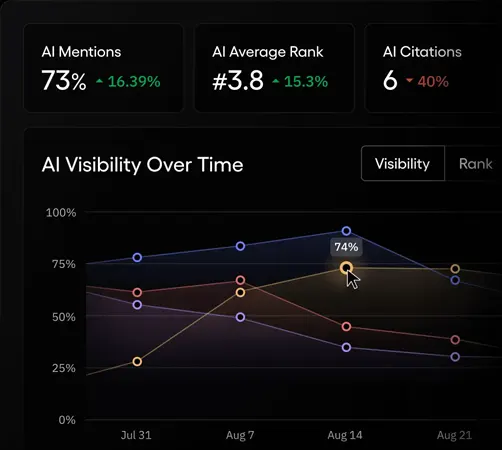
What Is AI Visibility Analytics?
AI visibility analytics refers to measuring how often a brand appears in AI-generated responses to real user questions.
Instead of focusing only on traditional metrics such as rankings or impressions, AI visibility analytics looks at questions like:
- Is your brand mentioned when users ask AI assistants for recommendations?
- How frequently does it appear compared to competitors?
- Which sources or pieces of content are influencing those AI responses?
These insights help organizations understand how AI systems interpret and represent their brand in conversations with users
Why Traditional Metrics Are No Longer Enough
For years, marketing strategies have relied on metrics such as search rankings, traffic, and click-through rates. While these remain valuable, they do not fully capture how generative AI systems are shaping the discovery process.
A company might rank well in search results but still be rarely mentioned by AI assistants. Since many users now begin their research by asking AI questions, this gap can affect how early impressions are formed.
Understanding visibility within AI responses adds another layer of intelligence to existing analytics.

The Strategic Impact for Brands
Analyzing how brands appear in AI-generated answers can provide several strategic benefits:
- Early insight into consumer discovery
Companies can see how AI assistants present their brand during the earliest stages of a user’s research. - Competitive benchmarking
Comparing how frequently different brands appear in AI responses can reveal shifts in competitive positioning. - Content strategy improvements
Understanding which sources influence AI-generated answers can help organizations refine their content and authority signals.
Several emerging tools are beginning to explore this space. For example, platforms such as BuzzSense analyze how brands appear across AI assistants and help organizations understand their visibility within AI-generated responses.
A New Layer of Digital Visibility
The way people discover brands online continues to evolve. Search engines, social platforms, and marketplaces have each shaped how businesses approach visibility. Now, AI assistants are becoming another gateway through which users explore products and services.
For brands, understanding this new layer of discovery will be increasingly important. Measuring how AI systems represent and recommend companies can offer valuable insights into how customers encounter brands in an AI-driven world.
As AI becomes a more common interface for information and decision-making, visibility inside these systems may become just as important as visibility in traditional search results.